

Sound made visible.
In a first-of-its-kind commission, acoustics researcher John Stuart Reid imaged the SomaEnergetics Solfeggio tuning forks on the CymaScope. The geometry of these six frequencies had never been seen before.
“This is an historic moment, since the geometry of these frequencies has never before been seen.”
John Stuart Reid · CymaScope.com
Six frequencies, six geometries
Each SomaEnergetics Solfeggio fork was recorded and its sound imprinted onto water, then imaged on the CymaScope. Select a frequency to see the full CymaGlyph and its data.
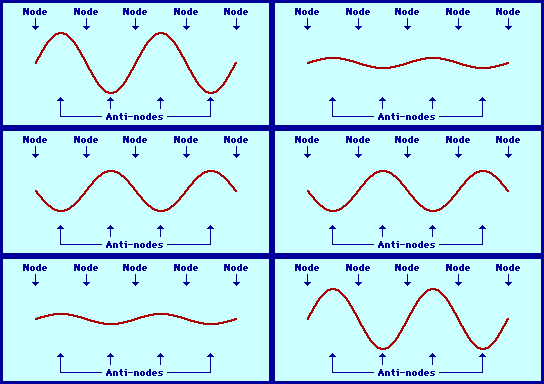
Antinodes are the points of maximum displacement in a standing wave — the opposite of nodes. A standing wave pattern is always an alternating sequence of nodes and antinodes.
The MI 528 Hz fork on the CymaScope
Filmed from the SomaEnergetics 528 Hz tuning fork — exclusive footage of a Solfeggio frequency taking form in water in real time.
The letter that came back with the images
John Stuart Reid is the British acoustics researcher who co-invented the CymaScope, the instrument that renders sound as visible geometry in water.
SomaEnergetics,
We have completed the imaging of your tuning forks. This is an historic moment since the geometry of these frequencies has never before been seen.
Most of the Solfeggio Antinodes are divisible by 3, 6 and or 9! Antinodes are the points that undergo the maximum displacement during each vibrational cycle of the standing wave. In a sense, these points are the opposite of nodes, and so they are called antinodes. A standing wave pattern always consists of an alternating pattern of nodes and antinodes.
In terms of the mathematical relationship between the numbers of antinodes and the golden ratio, one formula for phi = 0.5 x [secant 72 degrees]. So any whole number devisor of 72 carries a strong mathematical relationship between phi and certain frequencies. 12 would work and so would 9, 8, 6, 3 and 2.
Distortions in the interior detail is caused by background noise in the recording of the tuning fork. In the case of the 852 — clear harmonics produced those beautiful patterns. The 417 Hz and 639 Hz produced better CymaGlyphs on the oscillator than with the tuning fork recordings.
This is fascinating work and you are to be congratulated and applauded for commissioning this research.
Most of the antinodes divide by 3, 6 and 9.
One formula for phi is 0.5 × secant 72° — so any whole-number divisor of 72 carries a strong mathematical relationship to the golden ratio. Twelve works. So do 9, 8, 6, 3 and 2.

What is cymatics?
Cymatics comes from the Greek for wave. It is the study of visible sound — what happens to matter when a frequency passes through it.
Galileo Galilei was the first to record the connection between sound, vibration and physical pattern, while scraping a brass plate with an iron chisel.
Robert Hooke — the first person to visualize a micro-organism — was next to document it. Running a bow along the edge of a flour-dusted glass plate, he watched nodal patterns emerge.
Cymatics is covered in depth in the SomaEnergetics Phase 1 Course.
“As I was scraping a brass plate with a sharp iron chisel in order to remove some spots from it and was running the chisel rather rapidly over it, I once or twice, during many strokes, heard the plate emit a rather strong and clear whistling sound: on looking at the plate more carefully, I noticed a long row of fine streaks parallel and equidistant from one another. Scraping with the chisel over and over again, I noticed that it was only when the plate emitted this hissing noise that any marks were left upon it; when the scraping was not accompanied by this sibilant note there was not the least trace of such marks.”
Galileo Galilei

Ernst Chladni
1756–1827 · German musician and physicist, known to many as the father of acoustics. Author of Discoveries Concerning the Theory of Music (1787).
Chladni covered a metal plate with sand — now called a Chladni plate — and drew a violin bow across its edge. Geometric patterns appeared in the sand.
- ✦ Sound waves affect physical matter
- ✦ Those changes can be repeated
- ✦ Vibration generates and influences pattern, shape and moving process
Dr. Hans Jenny
Swiss medical doctor, natural scientist and author. Coined the term cymatics and published Cymatics: A Study of Wave Phenomena in 1967.
Jenny created “sound forms” using various mediums on a steel plate.
Crystal oscillators and frequency generators let him control resonant frequencies precisely — making the experiments repeatable in a laboratory.
When Hebrew and Sanskrit vowels were pronounced, the sand took the shape of the written symbol for those vowels. Modern languages did not produce the patterns.
He hypothesized that different frequencies influence genes, cells and bodily structures — and that sound could therefore be therapeutic.
Vibrations, oscillations, pulses, wave motions, pendulum motions, rhythmic courses of events and serial sequences affect everything — including biological evolution.
The forks that made these images
Every CymaGlyph on this page came from a SomaEnergetics fork. These are the same instruments — precision-tuned, made to hold their pitch for a lifetime.
Solfeggio Energy Tuners
396 · 417 · 528 · 639 · 741 · 852 Hz
All six imaged frequencies in one set — our exclusive etheric-color Energy Tuners, the forks Reid recorded for this study.
528 Hz Love Tuner
The MI frequency on its own — the one you just watched form in water.
Phase 1 Course
Cymatics is taught in full in the SomaEnergetics Phase 1 training, alongside the Solfeggio protocol.